
Building Auth from Scratch vs Using Ready-Made Auth Infrastructure
Compare building authentication from scratch with using ready-made infrastructure like LessOTP for inbound WhatsApp and Telegram authentication.
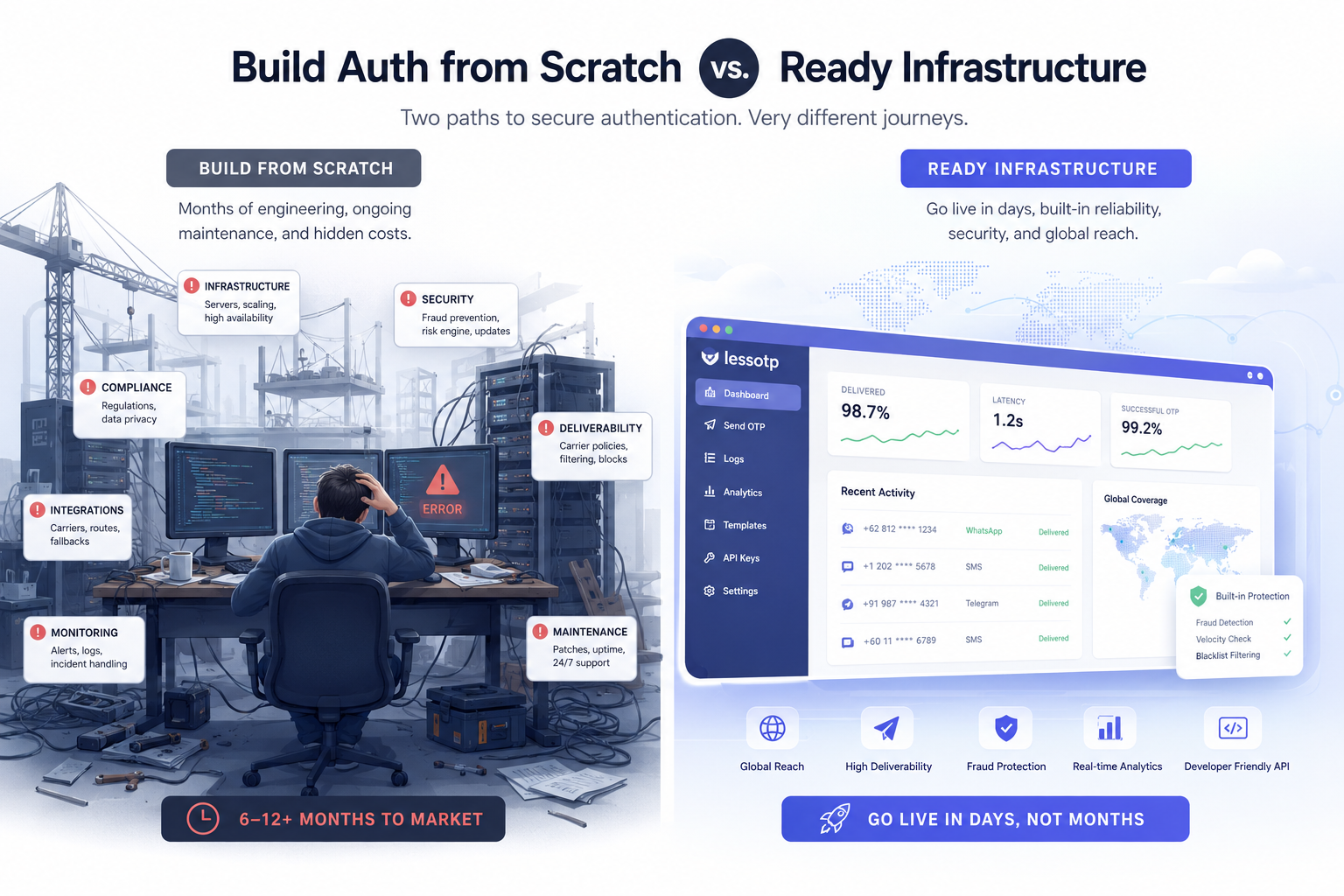
Auth Looks Simple Until It Hits Production
Building authentication from scratch often looks easy: create an OTP request endpoint, store a code, send a message, then match the user's input. The problem is that auth is not just a login form. In production, it becomes a critical path touching security, cost, fraud, support, and onboarding experience.
For B2B SaaS teams, the healthier question is not 'can we build this ourselves?' but 'is auth our core product differentiator, or infrastructure we should standardize?'
Building from Scratch vs Using Ready-Made Auth Infrastructure
| Aspect | Build from Scratch | Ready-Made Auth Infrastructure |
|---|---|---|
| Time to Ship | Weeks to months for APIs, workers, retries, dashboards, and monitoring | API + webhook integration, then staging validation |
| Delivery Risk | You manage providers, callbacks, timeouts, and delivery states yourself | Inbound WhatsApp/Telegram flows are standardized |
| Webhook Security | You design HMAC, idempotency, replay handling, and audit logs | Signed webhooks + idempotency keys are part of the product contract |
| Operational Cost | Engineering cost + provider cost + incident response | Billed per successful production verification |
| Team Focus | Your team maintains auth plumbing and edge cases | Your team focuses on core features and user activation |
When Does Building It Yourself Make Sense?
Building auth in-house still makes sense when authentication is a core differentiator, you have a dedicated security/infra team, and you are ready to operate the system 24/7.
- You need full control over a highly custom authentication protocol.
- Your product operates in a regulated domain that requires a specific internal auth design.
- Your volume and infra team are large enough to justify long-term operational cost.
When Is Ready-Made Auth Infrastructure the Better Choice?
For most B2B SaaS products, auth is the path into product value, not the product value itself. Ready-made infrastructure helps reduce implementation time without giving up backend control.
- You want faster new-user onboarding without waiting for SMS OTP or verification emails.
- You need App-level API keys, signed client webhooks, a staging simulator, and audit logs without building another internal dashboard.
- You want to avoid SMS costs that happen before a verification actually succeeds.
- You still want your backend to receive verification results and provision users according to your own product rules.
LessOTP as an Authentication Infrastructure Layer
LessOTP does not replace your account system. It handles inbound verification requests, phone identity validation, credit deduction only on success, and signed webhook delivery. Your app remains the source of truth for users, roles, workspaces, and permissions.
1. Your SaaS backend creates a verification request through the LessOTP API.
2. The user sends `/START {{unique_code}}` via WhatsApp or `/start {{unique_code}}` via Telegram.
3. LessOTP validates the code and phone identity from official providers.
4. Your backend receives the `verification.success` webhook and creates a session, account, or workspace.
Do not build auth plumbing when it is not your differentiator
Test LessOTP in staging: request auth, simulate inbound, and receive a signed webhook without sending real messages or deducting credit.
Try LessOTP Auth Infrastructure