
Built-in Fraud Protection vs Building Security Controls Yourself
Compare custom fraud controls around SMS OTP with LessOTP's structural inbound auth defenses, from traffic pumping to signed webhooks.
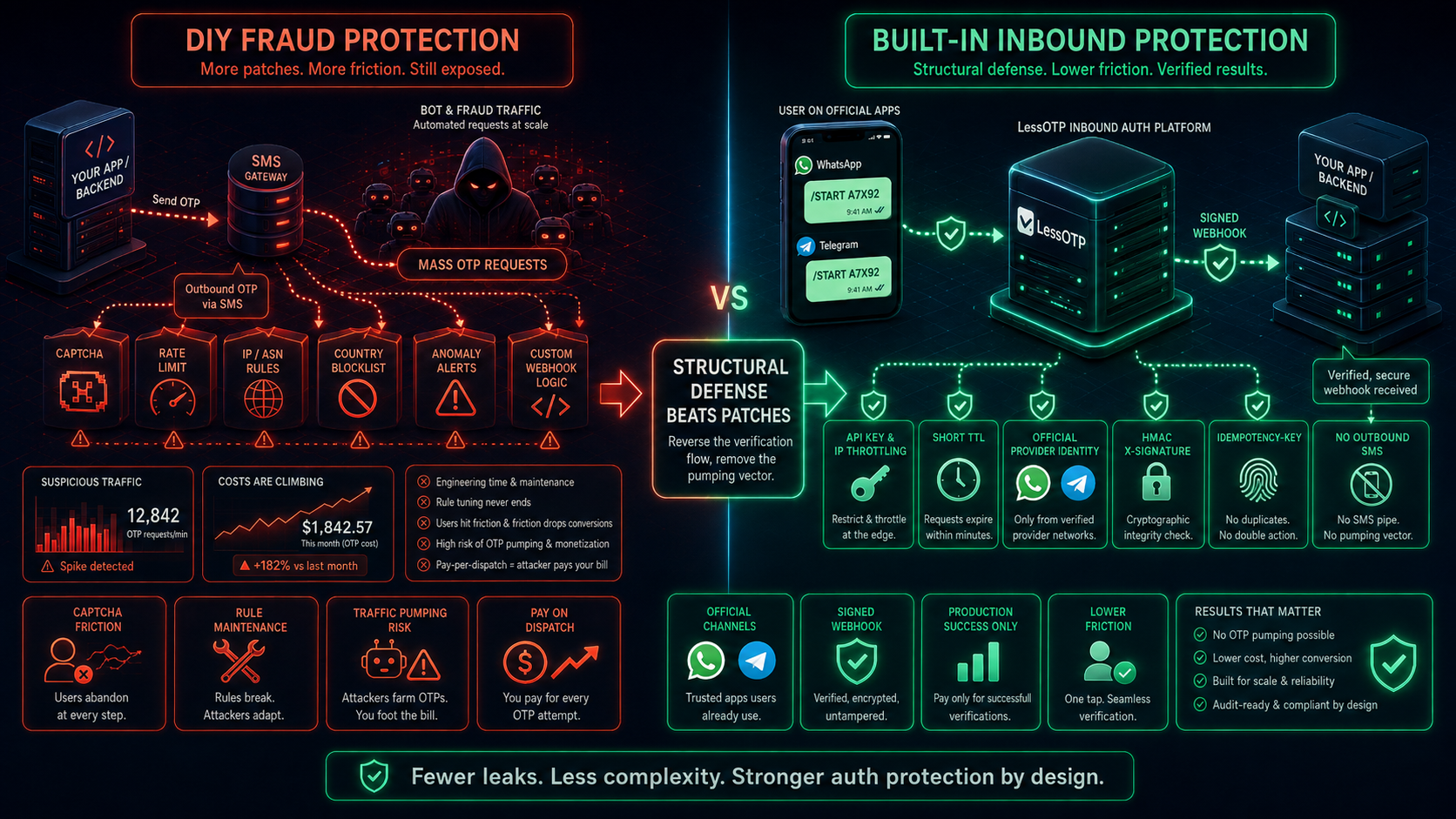
OTP Fraud Cannot Be Solved by Patching CAPTCHAs and Rate Limits Alone
Whenever a product team exposes a public login or registration endpoint that dispatches outbound SMS OTPs, they immediately enter an arms race against bot fraud, SMS traffic pumping (IRSF), and automated abuse.
Many engineering teams attempt to build custom fraud protection: IP rate limiters, CAPTCHAs, country prefix blocklists, and device reputation scoring. Unfortunately, these patch-ups often add friction for legitimate users while still leaking messaging costs.
Comparison: DIY Fraud Protection vs Built-in Inbound Defense
| Aspect | DIY Layer on Outbound SMS | Built-in Inbound Auth (LessOTP) |
|---|---|---|
| Attack Economics | Attacker triggers SMS; victim app pays the delivery cost | Attacker must send inbound messages; no outbound SMS to monetize or pump |
| Implementation Overhead | Requires Redis rate limiters, IP intelligence, CAPTCHAs, and custom rule engines | Built-in: API key & IP throttling, short-lived TTLs, and signed webhooks |
| Legitimate User Friction | Users frequently encounter difficult CAPTCHAs or blocked OTPs on shared mobile IPs | Users simply tap to send a prefilled verification message via WhatsApp or Telegram |
| Number Ownership Proof | The app guesses whether the recipient is truly the legitimate sender | Directly verified by official providers (Kirimdev WhatsApp API & Telegram Bot API) |
| Billing Model | Pay per dispatched SMS, including failed or fraudulent verification attempts | Credit is deducted strictly on successful production verifications |
The Operational Burden of Building DIY Fraud Protection
When building custom fraud defenses around traditional outbound SMS, engineering teams must maintain a complex stack:
- Multi-Layer Rate Limiting: Maintaining throttling rules across phone numbers, client IPs, ASNs, and device sessions.
- Country Blocklist Management: Continually updating international prefix rules to block suspicious high-cost premium destinations.
- Toll Fraud Anomaly Alerts: Monitoring dispatch spikes in real time to prevent overnight budget drains.
- Webhook Security Architecture: Designing HMAC validation, replay defense, and idempotency pipelines from scratch.
Structural Protection: Reversing the Verification Flow
LessOTP eliminates OTP fraud not by piling on heuristic rules, but by fundamentally changing the underlying architecture:
- Removes the Outbound Traffic Pumping Vector: With zero outbound SMS dispatches, attackers cannot abuse your endpoints to generate paid SMS traffic.
- Official Provider Identity: The phone number is verified directly through active WhatsApp or Telegram accounts.
- Idempotency & Replay Defense: Every webhook delivery includes an HMAC SHA-256 X-Signature and Idempotency-Key header to prevent duplicate state changes.
- Safe Staging Sandbox: Staging mode lets you test end-to-end webhook handlers without incurring costs or sending real messages.
Stop SMS cost leaks caused by auth fraud
Switch to LessOTP's inbound authentication infrastructure and test secure verification flows in the staging simulator for free.
Test Inbound Protection in Staging