
Developer Challenges in OTP Implementation
Explore the top 5 challenges developers face when implementing SMS OTP—from delivery latency and traffic pumping to unexpected costs—and how inbound auth solves them.
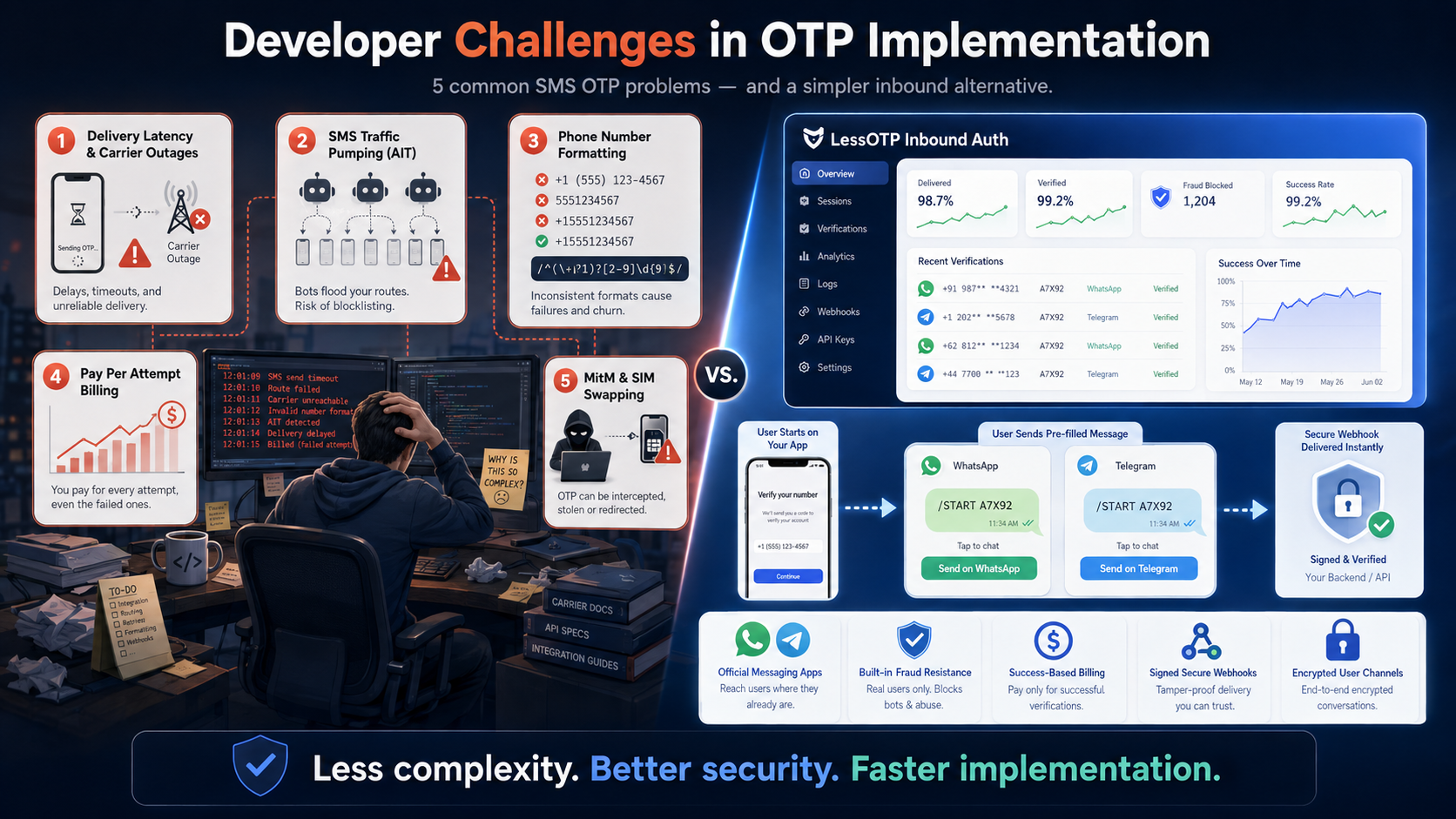
Why does SMS OTP implementation always create technical debt?
Integrating SMS OTP appears straightforward initially: call a vendor API, dispatch a 6-digit code, and verify user input. In production, engineering teams face carrier routing failures, international phone number formatting issues, and unexpected financial risks.
This article covers the top 5 challenges developers face when building traditional OTP systems and shows how inbound WhatsApp/Telegram authentication resolves them.
Top 5 developer challenges in SMS OTP
1. Delivery Latency and Carrier Outages
SMS delivery routes through aggregators, SMSCs, and mobile networks. Failures at any point cause delayed or lost messages, prompting users to repeatedly click 'Resend OTP'.
2. Threat of SMS Traffic Pumping (AIT)
Unprotected public forms can be targeted by bots triggering thousands of SMS messages to premium international routes, forcing developers to build complex rate limiters and CAPTCHAs.
3. Phone Number Formatting and Regex Parsing
International phone numbers vary widely (E.164, trunk prefixes, leading zeros). Formatting bugs lead to failed SMS delivery or login mismatches.
4. Pay-Per-Attempt Billing Without Delivery Guarantees
SMS vendors charge upon message dispatch rather than successful verification. Expired OTPs or signal drops still consume your application balance.
5. Man-in-the-Middle (MitM) & SIM Swapping
Plaintext SMS lacks end-to-end encryption. Flaws in legacy SS7/Diameter networks and SIM swapping make SMS OTPs vulnerable to interception.
Technical comparison: SMS OTP vs Inbound Auth
| Technical Parameter | Traditional SMS OTP | Inbound Messaging (LessOTP) |
|---|---|---|
| Initiation Direction | Outbound push from server | Inbound pull from user app |
| Cost Per Attempt | Charged per dispatch | Free (deducted only upon successful verification) |
| Traffic Pumping Defense | Requires custom bot protection | Inherently secure by architecture |
| Network Encryption | No E2EE (SS7/Diameter) | Native E2EE via WhatsApp/Telegram |
| Webhook Handling | Manual provider status polling | Automated HMAC SHA-256 with Idempotency-Key |
Free testing in the Staging Simulator
LessOTP offers per-App staging mode. Developers can execute request APIs and test client webhooks without sending real messages or deducting credits.
curl -X POST https://lessotp.com/api/v1/staging/auth/request \
  -H "Authorization: Bearer YOUR_STAGING_API_KEY" \
  -H "Content-Type: application/json" \
  -d '{
    "channel": "whatsapp"
  }'
Expected response:
{
  "status": "success",
  "data": {
    "request_id": "req_8f7d6c5b4a",
    "unique_code": "A7X92",
    "channel": "whatsapp",
    "wa_link": "https://wa.me/628999999999?text=/START+A7X92",
    "expires_in": 180,
    "mode": "frictionless"
  }
}
Use the Dashboard Simulator to dispatch synthetic events. Your backend webhook receives signed payloads:
{
  "event": "verification.success",
  "channel": "whatsapp",
  "request_id": "req_8f7d6c5b4a",
  "phone_number": "6281234567890",
  "timestamp": "2026-08-24T10:00:00Z"
}
HMAC SHA-256 webhook security
Verify webhook signatures on your server using your App signing secret to guarantee payload integrity and prevent replay attacks:
import { createHmac, timingSafeEqual } from "node:crypto";

function verifyLessOTPWebhook(rawBody: string, signature: string, secret: string) {
  const expected = createHmac("sha256", secret).update(rawBody).digest("hex");
  const received = Buffer.from(signature, "hex");
  const expectedBuffer = Buffer.from(expected, "hex");

  return received.length === expectedBuffer.length &&
    timingSafeEqual(received, expectedBuffer);
}

// Simpan Idempotency-Key dan abaikan delivery yang sudah pernah diproses.
Explore complete technical specs in LessOTP developer docs.
Simplify authentication without SMS OTP overhead
Adopt Inbound WhatsApp & Telegram Auth. Test your integration in the LessOTP Staging Simulator in minutes for free.
Start staging test