
Why Phone Number Ownership Validation Matters in Authentication
Understand why format validation is not enough and why proving phone ownership via WhatsApp and Telegram is essential for authentication security.
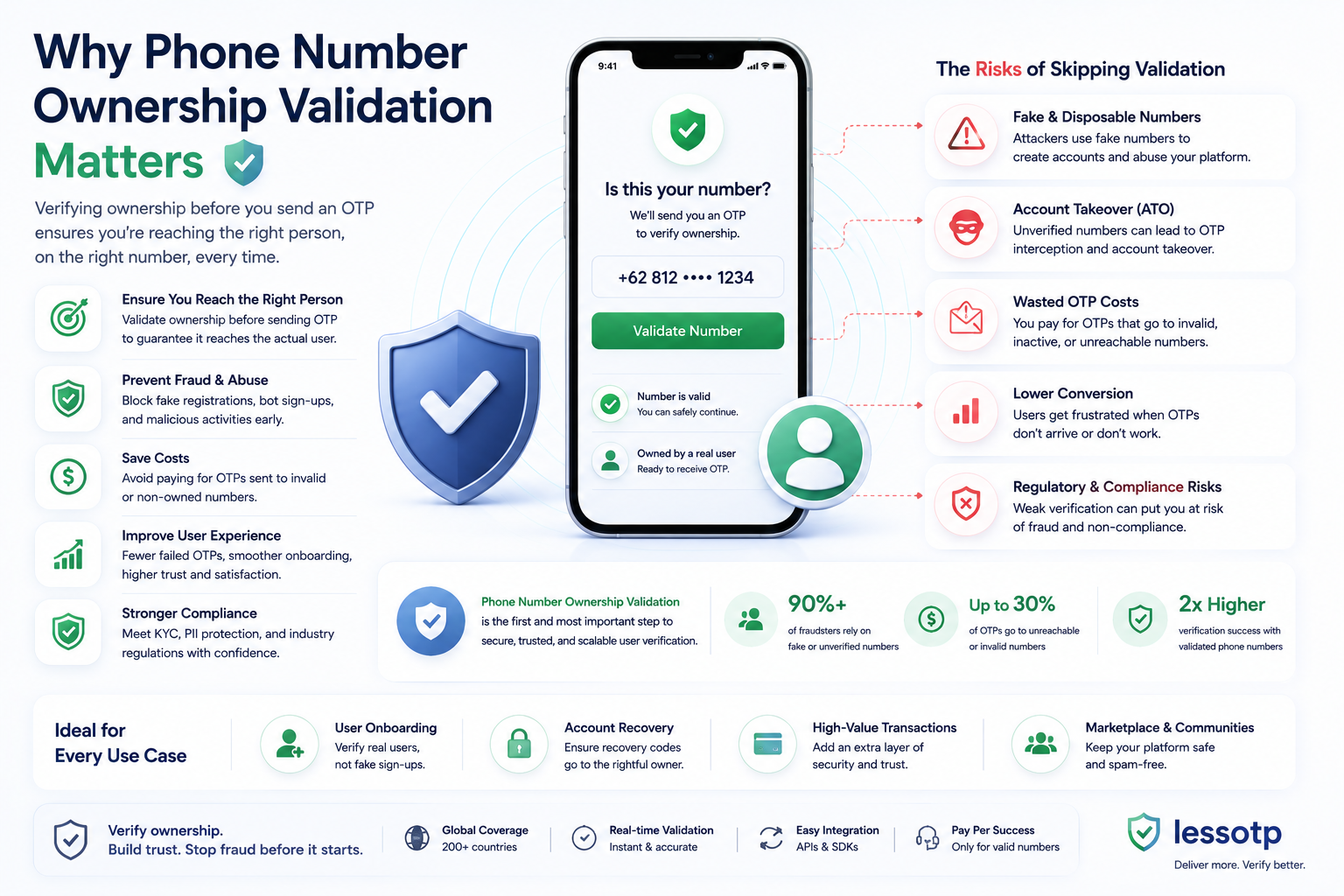
A Phone Number Is More Than a Contact Field
In modern authentication flows, phone numbers often act as identifiers, recovery methods, and risk signals. That means the important question is not just whether the number has a valid format, but whether the current user actually controls that number.
Phone number ownership validation answers the core question: can the user claiming this number prove control over the official channel connected to it? Without that proof, applications can accept fake data, someone else's number, or numbers that are no longer reachable.
Risks of Format-Only Phone Validation
Accounts Linked to Someone Else's Number
Users can mistype or intentionally submit another person's number. Recovery flows and security notifications may then reach the wrong recipient.
Low-Quality Leads
Signup forms may collect random numbers that look valid syntactically but cannot be used for login or follow-up.
Harder Fraud and Abuse Filtering
If your app stores only a number string without ownership proof, bots can create accounts using fake or recycled data more easily.
Format Validation vs Ownership Validation
| Aspect | Format Validation Only | Phone Ownership Validation |
|---|---|---|
| What It Proves | The string looks like a phone number | The user controls the channel connected to that number |
| Usefulness for Auth | Weak: mainly input sanitization | Strong: suitable for login, signup, recovery, and step-up auth |
| Typo Risk | Still high | Lower because the number comes from official WhatsApp/Telegram interaction |
| Audit Trail | Only a number string from a form | request_id, channel, timestamp, and verified webhook payload |
How LessOTP Proves Phone Number Ownership
LessOTP uses inbound authentication so ownership proof comes from the user's action on an official messaging channel:
- WhatsApp: the user sends `/START {{unique_code}}` from an active WhatsApp number through Official WhatsApp API Business Partner Kirimdev.
- Telegram: the user opens the bot, sends `/start {{unique_code}}`, then shares their phone through the official Share phone number button. LessOTP rejects contacts when `contact.user_id` does not match `message.from.id`.
- Strict Mode: the number stored in your database must match the proven inbound number.
- Frictionless Mode: the verified inbound number can create a new account without manual phone input.
Validate real ownership, not just phone number format
Try LessOTP in staging to see how request_id, channel, phone_number, and signed webhooks work together.
Test Phone Validation in Staging