
Why Can WhatsApp and Telegram Delivery Rates Approach 100%?
Learn why inbound WhatsApp and Telegram authentication can achieve high completion rates, how to measure them, and where the limits are.
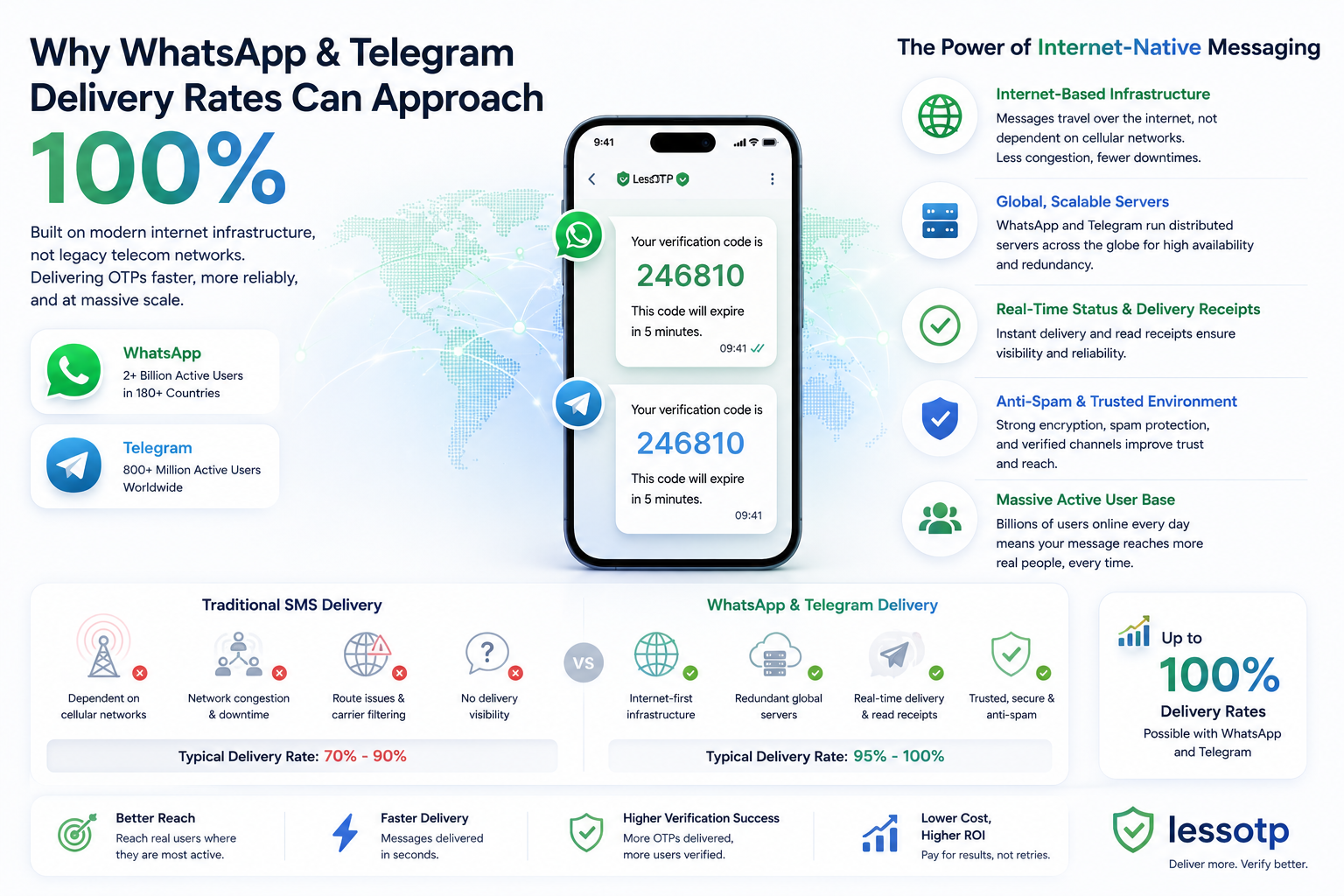
The short answer: the user starts the conversation
WhatsApp or Telegram delivery can approach 100% in a healthy inbound authentication flow, but that number is not a platform guarantee. It depends on the metric definition, integration quality, user connectivity, and who is included in the denominator.
The main difference from SMS OTP is message direction. The user opens an active chat app, sends a code or shares their phone number, and the provider forwards that event to the backend. The system does not have to guess whether an outbound SMS can cross every carrier hop and arrive on time.
Make sure you measure the right metric
The term delivery rate often combines four different stages. Separate them so the number does not look better or worse than reality.
| Metric | What it counts | What it means |
|---|---|---|
| API acceptance | Requests accepted by the provider | It does not prove that a message reached a device. |
| Provider delivery | Messages reported as delivered | WhatsApp exposes delivery status; Telegram Bot API has no equivalent device-level receipt for bots. |
| Flow completion | Users who finish the chat steps | Includes user behavior, expiry, and UX. |
| Verification success | Identities that pass every validation | Includes code, phone, ownership, balance, and idempotency checks. |
Why can the number be so high?
The user selects the channel
A user who taps WhatsApp or Telegram usually has the app installed, an active account, and a data connection. This filters out many unreachable destinations before messaging starts.
The app session is active
The flow starts with a deep link. The user moves directly into the chat app instead of waiting for a message in another inbox that may be delayed, filtered, or ignored.
Inbound proves an action occurred
When the backend receives a WhatsApp message or Telegram contact update, it already has evidence of user action. That signal is stronger than an API response saying an outbound message was accepted for processing.
Internet routing replaces the SMS chain
The message does not depend on SMS interconnections across aggregators and carriers. Network and provider dependencies remain, but fewer telecom delivery points can fail.
There is no OTP copy and paste
The deep link carries the login code into the conversation. On Telegram, the user continues with the official Share phone number button. Less manual input means fewer typing errors and fewer long context switches.
Webhooks can be retried safely
Providers and platforms can retry events that were not acknowledged. A backend that verifies signatures and enforces idempotency can accept retries without creating duplicate logins or debits.
WhatsApp and Telegram do not provide the same delivery evidence
Meta's official documentation distinguishes sent, delivered, read, and failed statuses. Delivered means the message reached the user's device, while read implies delivery. These statuses are useful for measuring the outbound confirmation sent after verification.
Telegram
Telegram Bot API returns API call results and forwards updates to a bot webhook, but it does not provide a WhatsApp-equivalent delivered/read receipt for bot messages on a recipient device. The honest Telegram auth metrics are therefore: /start update received, sender-owned contact received, and verification completed.
Primary contracts: WhatsApp status webhooks and the Telegram Bot API.
When will delivery not approach 100%?
Do not promise an absolute number. Even a strong inbound flow still fails when:
- the user does not have the app, is offline, or abandons the flow;
- the deep link is wrong, the code has expired, or the device clock causes trouble;
- the business account, WhatsApp number, or Telegram bot is blocked or unavailable;
- a Telegram user refuses to share their phone number or shares someone else's contact;
- the backend webhook is slow or unavailable, validates signatures incorrectly, or treats retries as new events;
- the denominator includes every API request, including users who never open the channel.
How to measure without misleading yourself
1. Define the denominator
Measure from request creation, deep-link open, and inbound message receipt. Report each separately.
2. Split by channel
WhatsApp and Telegram have different steps and observability signals.
3. Record failure reasons
Separate abandonment, expiry, mismatch, provider errors, webhook errors, and duplicates.
4. Use time cohorts
Compare equivalent users, countries, app versions, and time periods.
5. Report latency percentiles
Alongside success rate, track p50, p95, and p99 time from request to verification.success.
Conclusion
WhatsApp and Telegram can produce very high completion rates because authentication is initiated by the user in an active channel, the code travels through a deep link, and the backend receives direct evidence of user action. What approaches 100% is flow completion for an eligible, engaged cohort, not a guarantee that every API request will always be delivered or verified.
See channel contracts, webhooks, signatures, and staging in the LessOTP API documentation.
Measure your flow with real events
Try WhatsApp and Telegram authentication, then validate the verification.success webhook before claiming a production delivery rate.
Try frictionless auth